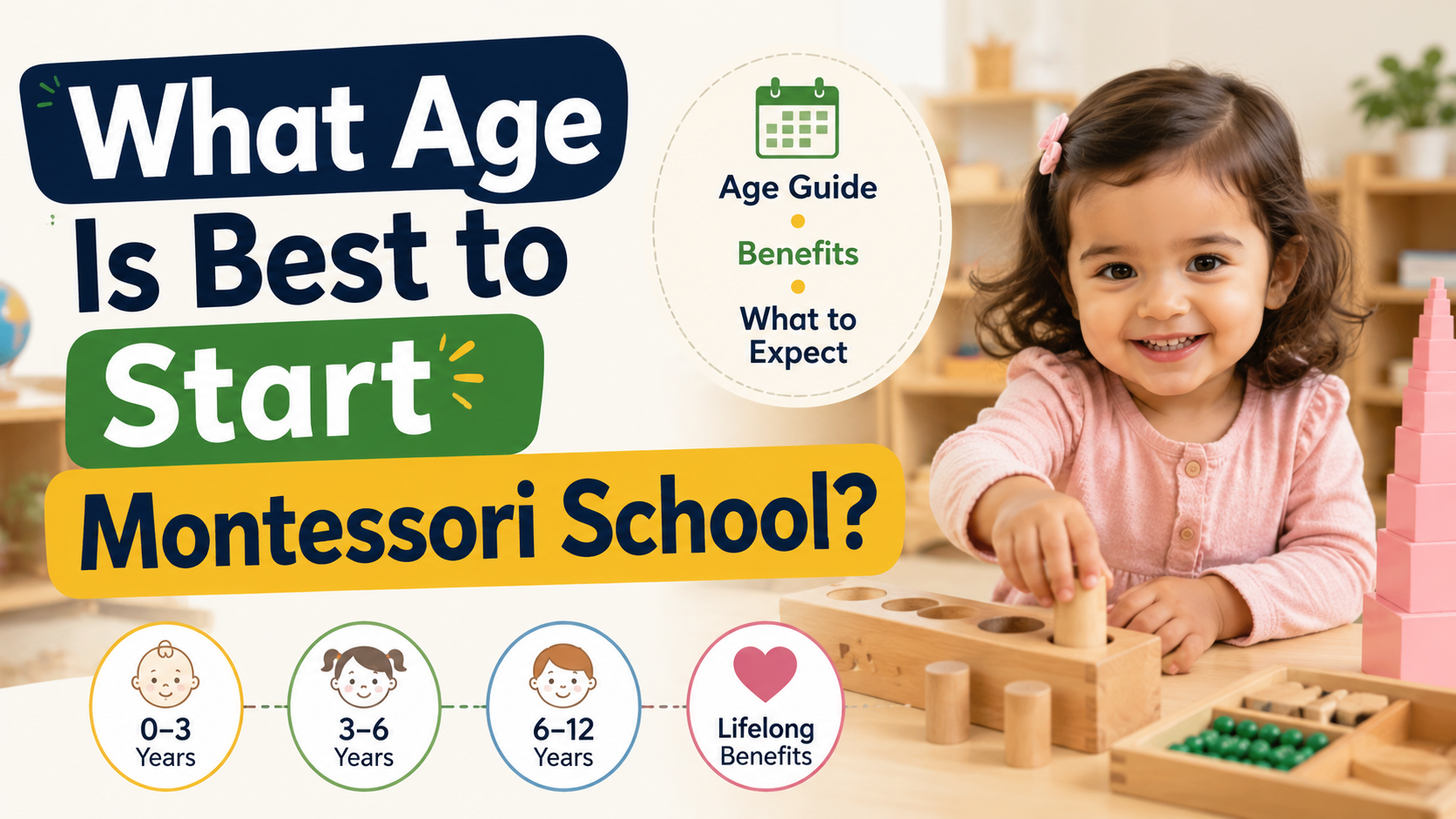
Choosing the right age to start your child's educational journey is one of the most important decisions parents make. Many parents often ask, "What age is best to start Montessori school?" The answer depends on your child's developmental stage, but most Montessori educators agree that children can begin benefiting from a Montessori environment as early as 18 months to 3 years of age.
A quality Montessori school provides a carefully prepared environment where children learn through exploration, hands-on activities, and self-directed learning. Unlike traditional classrooms, Montessori education focuses on developing independence, confidence, and a lifelong love of learning.
In this article, we'll explore the ideal age to start Montessori education, the benefits of early enrollment, and how a Montessori playschool can support your child's growth and development.
Understanding the Montessori Method
The Montessori method was developed by Dr. Maria Montessori over a century ago. It is based on the belief that children learn best when they are allowed to explore and discover at their own pace.
A Montessori classroom is designed to:
- Encourage independent learning
- Promote creativity and curiosity
- Develop practical life skills
- Improve concentration and focus
- Build social and emotional confidence
Children are given age-appropriate materials and activities that match their developmental needs.
What Age Can Children Start Montessori School?
Most Montessori schools offer programs for different age groups:
18 Months to 3 Years: Toddler Program
Many Montessori schools welcome children as young as 18 months. At this age, children are naturally curious and eager to explore the world around them.
The toddler program focuses on:
- Language development
- Fine motor skills
- Social interaction
- Self-care activities
- Sensory exploration
This stage helps children develop independence while feeling safe and supported.
2.5 to 3 Years: Preschool or Playschool Program
Many experts consider this the ideal age to start a Montessori playschool.
At this age, children begin to:
- Follow simple instructions
- Communicate effectively
- Participate in group activities
- Develop friendships
- Learn basic routines
The Montessori playschool environment encourages learning through play while building essential life skills.
3 to 6 Years: Primary Montessori Program
The primary Montessori program is one of the most popular stages of Montessori education.
Children learn:
- Reading and writing readiness
- Early mathematics
- Science concepts
- Cultural studies
- Practical life skills
By this age, children can fully engage with Montessori materials and enjoy a rich learning experience.
Why Starting Early Can Be Beneficial
Starting Montessori education during the early years offers several advantages.
1. Supports Brain Development
The first six years of life are crucial for brain development. During this period, children absorb information quickly and naturally.
A Montessori school provides stimulating experiences that encourage healthy cognitive growth.
2. Builds Independence
Montessori classrooms are designed to help children do things for themselves.
Children learn to:
- Put away materials
- Serve snacks
- Dress themselves
- Care for their environment
These simple tasks build confidence and independence.
3. Develops Social Skills
In a Montessori playschool, children interact with peers in a respectful and cooperative environment.
They learn:
- Sharing
- Communication
- Problem-solving
- Teamwork
- Empathy
These social skills prepare them for future success in school and life.
4. Encourages a Love of Learning
Rather than relying on rewards or punishments, Montessori education motivates children through curiosity and discovery.
Children develop a positive attitude toward learning that can last a lifetime.
Is There Such a Thing as Starting Too Early?
Every child develops at a different pace.
Some children are ready for a Montessori playschool at 18 months, while others may benefit from starting closer to age 3.
Parents should consider:
- Emotional readiness
- Communication skills
- Ability to separate from caregivers
- Interest in social interaction
- Curiosity about the environment
A good Montessori school will help assess whether a child is ready for enrollment.
Signs Your Child Is Ready for Montessori School
Your child may be ready if they:
- Show curiosity about new things
- Enjoy exploring independently
- Follow simple instructions
- Demonstrate interest in other children
- Can participate in simple routines
- Show a desire to do tasks independently
These signs often appear between ages 2 and 3.
Why Parents Choose Montessori Playschools
A Montessori playschool offers more than just childcare.
It provides a structured environment where children can:
- Learn through hands-on experiences
- Develop independence
- Improve communication skills
- Build confidence
- Prepare for formal schooling
Parents appreciate the personalized approach that allows each child to progress at their own pace.
Montessori School vs Traditional Playschool
Montessori School
- Child-led learning
- Hands-on educational materials
- Mixed-age classrooms
- Focus on independence
- Individual learning pace
Traditional Playschool
- Teacher-directed activities
- Fixed curriculum
- Same-age groups
- More structured schedules
- Group-based instruction
Both approaches have benefits, but many parents prefer Montessori education because it encourages natural development and self-motivation.
Choosing the Right Montessori School
When selecting a Montessori school, consider:
- Qualified Montessori-trained teachers
- Safe and child-friendly classrooms
- Age-appropriate learning materials
- Positive learning environment
- Good communication with parents
Visiting the school and observing classrooms can help parents make an informed decision.
Final Thoughts
So, what age is best to start Montessori school?
For most children, the ideal age is between 2.5 and 3 years old, when they are ready to benefit from social interaction, structured routines, and hands-on learning. However, many children can begin Montessori programs as early as 18 months.
A high-quality Montessori school or Montessori playschool provides children with the foundation they need for academic success, independence, and personal growth. By starting early, parents can help nurture confidence, curiosity, and a lifelong love of learning.
Frequently Asked Questions (FAQs)
1. What is the best age to start Montessori school?
Most children benefit from starting Montessori school between 2.5 and 3 years of age, although some programs accept children as young as 18 months.
2. Can a 2-year-old attend a Montessori playschool?
Yes. Many Montessori playschools offer toddler programs specifically designed for children between 18 months and 3 years.
3. Is Montessori better than a traditional playschool?
Montessori focuses on child-led learning, independence, and hands-on experiences, while traditional playschools often follow teacher-led activities.
4. What do children learn in a Montessori school?
Children learn practical life skills, language, mathematics, sensory activities, social skills, and problem-solving through hands-on learning.
5. How do I know if my child is ready for Montessori school?
Signs include curiosity, independence, interest in social interaction, and the ability to follow simple instructions.
6. Can Montessori education help shy children?
Yes. Montessori classrooms provide a supportive environment that helps children gradually build confidence and social skills.
7. Do Montessori schools prepare children for primary school?
Absolutely. Montessori programs develop academic, social, emotional, and practical skills that prepare children for future education.
8. Why do parents prefer Montessori playschools?
Parents appreciate the focus on independence, individualized learning, creativity, and overall child development.